
New Russia Sanctions, Unbridled Tariff Authority, and Questionable Results
July 27, 2026
by Randi B. Levinas*
Historically, Russia sanctions bills in the U.S. Congress have been bipartisan, popular, and quick to garner easy – indeed, overwhelming - approval almost as soon as Washington begins buzzing about them. You blink, and suddenly Congress has codified sanctions against Russia.
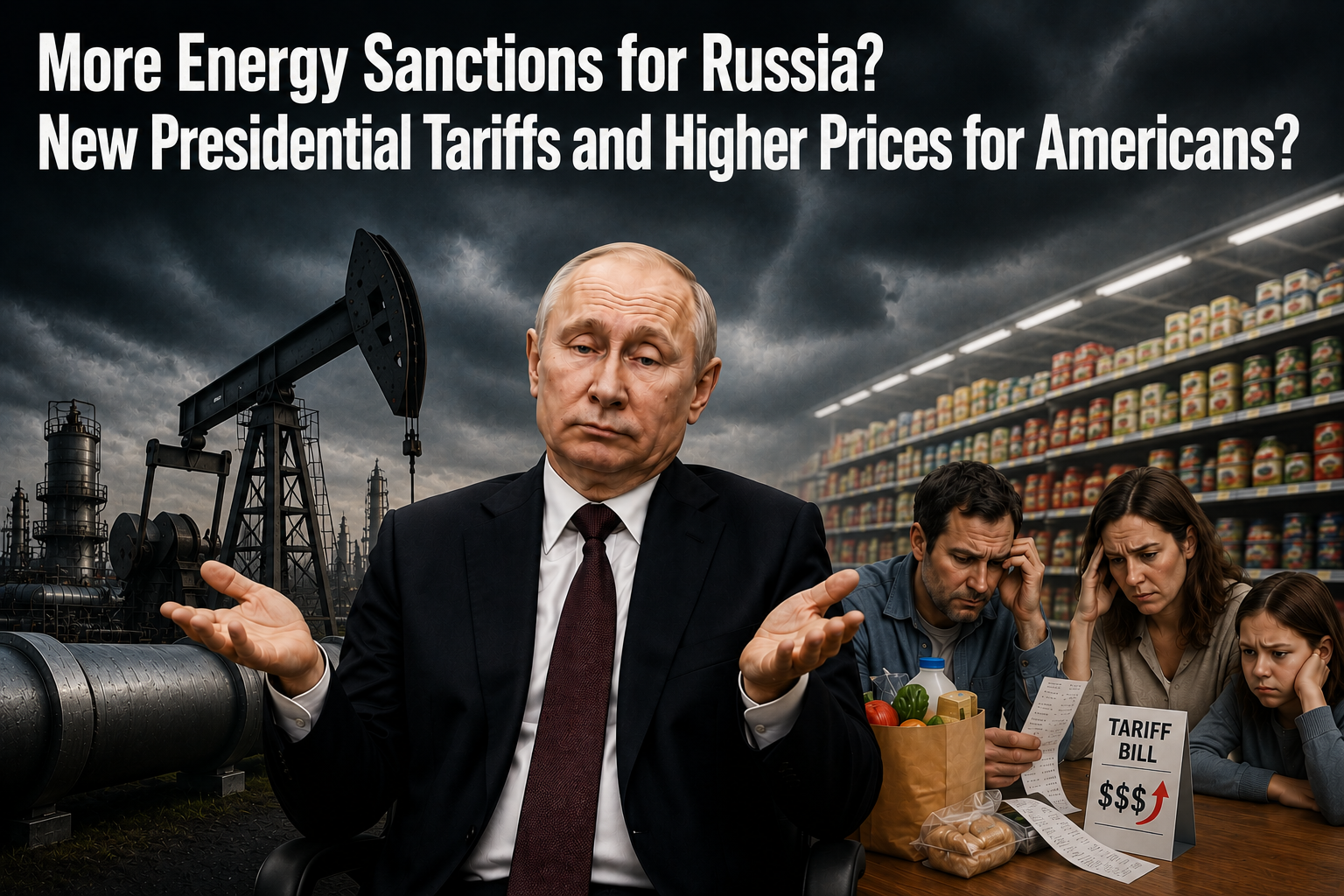
And here we are again, with a new Russia sanctions bill suddenly lurching forward – yet this time with Constitutional and economic consequences. With tariffs raining down on all sides as an empowered Executive Branch has homed in on tariffs as its preferred economic weapon of choice, the latest Russia sanctions bill carries not only an intended punch to Russia’s energy economy, it also opens a new pandora’s box on tariff authority and affordability questions.
The bill, initially authored by the late fierce Russia critic and ardent Ukraine supporter Senator Lindsey Graham (R-SC), shot onto DC’s radar after the Senator’s last visit to Ukraine. It allows for new sanctions against Russia and, additionally, steep tariffs against U.S. trading partners. Depending on how the tariffs against trading partners are implemented, the result would be yet another opportunity to raise costs for American workers and families.
A bipartisan coalition of 62 Senators as of this writing – including Senate Majority Leader John Thune (R-SD) - support the “Lindsey O. Graham Sanctioning Russia Act of 2026” (S.5025), which has been referred solely to the Senate Banking Committee. A companion measure sponsored by Rep. Michael McCaul (R-TX) is expected to emerge[1], and this may allay Democrats’ concerns regarding the bill’s tariff authorities. If it does not, support may splinter. With Ukraine’s President Volodymyr Zelenskyy in Washington for Senator Graham’s funeral and a White House meeting, there may be sufficient political will to push a bill towards passage.
Breaking New Ground with Sanctions and Tariffs
It has been some time since Congress moved Russia sanctions legislation. The potential codification of numerous new and important sanctions – albeit subject to Presidential waivers – can be seen as mere messaging to Russia and Ukraine about a desire to see an end to the war, but it can also be seen as indication that Congress still believes it may be able to change President Putin’s behavior by hitting Russia’s finances and limiting Russia’s access to energy revenue.
Tariff Provisions. Senate sponsors are rallying around tariff language that represents a bold leap in ceding of Constitutional tariff authority to the President, and this is the concern that Rep. McCaul seems poised to address.
Specifically, citing no existing trade statute, Section 113 of S. 5025 would allow the President to apply tariffs of up to 100% against countries that:
1. Knowingly made new purchase of crude oil or natural gas from Russia starting 30 days after the bill’s enactment.
2. Were among the top 5 largest importers of Russian oil by volume in the last 12 months.
3. Were among the top 5 largest importers of Russian natural gas by volume in the last 12 months (however, countries accounting for less than 15% of Russia’s total natural gas exports or that have taken “significant steps” to reduce Russian natural gas imports would be exempted); and
4. Were among the top 5 countries facilitating Russian oil sanctions evasion – which as defined in the bill would include significant financial support for purchase, loading, or shipment of sanctioned Russian oil and engaging in any transaction, activity or service related to a shadow fleet vessel that transported, is transporting, or is attempting to transport sanctioned Russian oil.
While countries that are not major importers of Russian natural gas may receive a “bye” given the bill’s construction, this still leaves numerous trading partners – including China – in the bill’s tariff crosshairs, adding more uncertainty to the global trade environment.
Senate Finance and House Ways & Means’ respective Ranking Members, Ron Wyden (D-OR) and Richard Neal (D-MA), have referred to the S. 5025’s tariff provisions as “a prescription for bedlam.” Indeed, Senator Wyden said last week that he was exploring procedural options to blocking the legislation.[2] Yet Wyden and Neal also said, “there is no question that the U.S. government must take stronger action against purchasers of Russian energy who are fueling the unjustifiable war against Ukraine.”[3]
It’s worthwhile, then, to review a sample of S.5025’s sanctions provisions that go beyond previous sanctions laws or Executive actions.
Sanctions Provisions
The bill codifies sanctions that have been instituted through Executive Orders, including:
o a blanket new investmentban in Russia by U.S. persons (section 107).
o a prohibition on services to sanctioned financial institutions by international financial messaging systems – with Executive waivers for the economic and foreign policy interests of the United States (Section 110).
It places sanctions on Rosatom, Russia’s nuclear agency, for the first time – previously its subsidiaries and officials had been sanctioned, but not the entity itself.
The bill permits U.S. or foreign financial institutions holding Russian sovereign assets to keep interest due to Russia on those assets. Importantly, the bill does not permit them to keep the interest on assets of blocked persons, which is an important distinction at a time when Russia’s use of its authorities to place Western companies under “external administration” is on the rise.
The bill also provides for exemptions that have been common in the past:
o the conduct or facilitation of a transaction for the provision of agricultural commodities, food, medicine, medical devices, humanitarian assistance or for humanitarian purposes:
o Carrying out or assisting any authorized intelligence or law enforcement activities of the United States.
o Compliance with UN and similar obligations:
o Civilian nuclear cooperation agreements.
o U.S. imports of low-enriched uranium or medical isotopes from Russia.
o Official U.S. government business:
o Non-Russian oil that transits Russian territory.
o U.S. persons operating under the terms of a general license issued by the U.S. Treasury Department before the date of enactment.
o Wind-down operations in Russia by non-Russian persons or U.S. persons.
o Safety of vessels and crews.
o NASA activities.
Whither the Sunset?
Another point of contention that has arisen with S. 5025 is its language that would leave sanctions and tariffs in place for an open-ended run. Specifically, the President has the authority - but is not required - to terminate sanctions, restrictions, or duties in the bill if the President submits a report to Congress certifying in writing that:
1. Russia has signed a peace agreement accepted by “the free and independent Government of Ukraine” and
2. has “ceased all military hostilities against and any activities to overthrow, dismantle and subvert the Government of Ukraine.”
This leaves the Executive as the sole decisionmaker regarding the application and termination of the sanctions and tariff provisions.
Looking Ahead
President Trump’s intention to include sanctions against Iran in S. 5025 may complicate support for the bill, but it also may not.
As far as the Congressional calendar is concerned, the current plans are for the House to stay in session through the end of July, and the Senate to be in Washington through the first week of August. That may be sufficient, but there is always September, when Congress will return for a short period, albeit with a packed agenda before the mid-terms. If the bill doesn’t move soon, some argue there won’t be floor time to consider the bill. But the issue of floor time for Russia sanctions bills has never been an obstacle, as noted above – Russia sanctions bills are strong candidates for overwhelming approval, at times with unanimous consent.
With Russia’s economy set to grow only .4% in 2026[4], inflation and interest rates on the rise, and the Central Bank reporting one of the steepest declines in business sentiment in recent years[5], many seem to be hoping that this legislative proposal might push Russia to end its conflict with Ukraine.
To date, no Western sanctions bill or Executive action has changed President Putin’s calculus regarding his designs on Ukraine. Considering that the amount of Russia-China trade conducted in yuan has soared from just 2% in 2022 to more than 90% today[6], it is clear that sanctioning Russia still carries unintended consequences.
But perhaps more concerning is that in its current form, this bill sets dangerous economic and trade powers precedents, which would likely add further strain diplomatic relations and raise costs on an already burdened American public. And it is uncertain whether it would finally entice Russia’s President toward peace.
***
*Randi B. Levinas is Founder & CEO of Levinas Advisory LLC. For more than a decade until 2023, she was the EVP and COO of the U.S.-Russia Business Council.
[1]https://x.com/RepMcCaul/status/2076215593154330910
[2] https://thehill.com/homenews/senate/5970400-democrats-oppose-russia-sanctions-act/
[3] Seeking to restore “stability” and “predictability” in U.S. trade policy by putting “Congress back in the driver’s seat,” Senator Wyden introduced legislation on July 22 to eliminate Section 122 and 338 authorities, and require Congressional approval for Section 301, 232 and 201 tariffs.
*Randi B. Levinas is Founder and CEO of Levinas Advisory LLC and is the former EVP and COO of the U.S.-Russia Business Council.
[4] https://www.reuters.com/business/russia-downgrades-2026-economic-growth-forecast-04-13-deputy-pm-says-2026-05-11/
[5] https://www.cbr.ru/eng/press/event/?id=32705
[6] https://www.forbes.com/sites/zennonkapron/2026/02/22/how-renminbi-internationalization-is-changing/
Galvanizing U.S. Business Ties with Central Asia
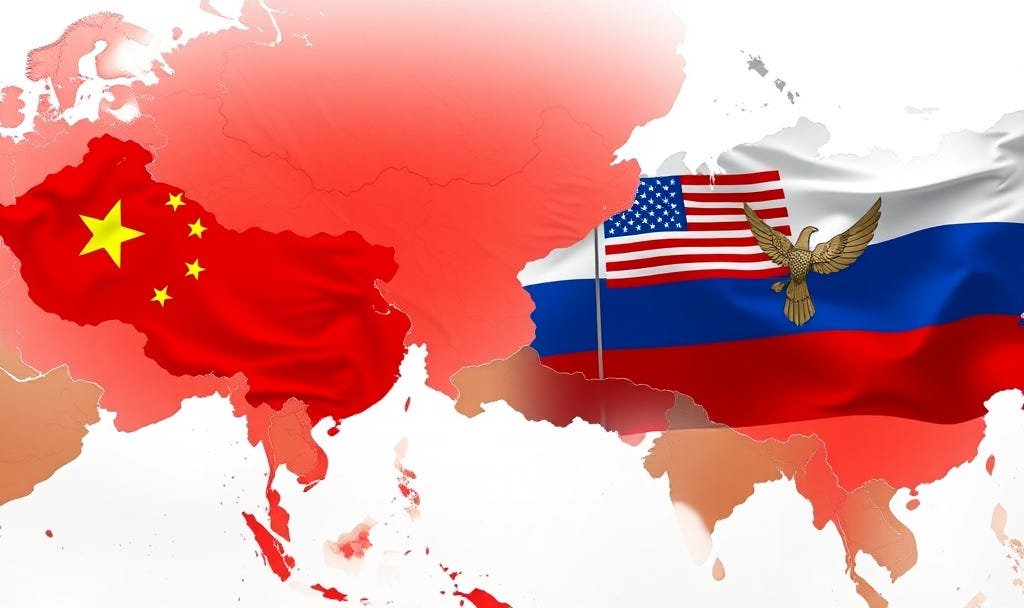
With their expansive deposits of critical minerals, youthful populations and growing GDPs, the economies of Central Asia (Kazakhstan, Uzbekistan, Tajikistan, Kyrgyzstan, and Turkmenistan) – the C5 - have inched onto the United States’ geopolitical and national and economic security radars.
But in a region where Russia and China have a tremendous foothold, three actions in which the United States can play a pivotal role might help enlarge and firmly plant the U.S. business footprint in the region:
(1) Clearer metrics about doing business in these economies.
(2) Building capacity with traditional U.S. business practices that encourage transparency and good governance; and
(3) Extending Permanent Normal Trade Relations to all the countries in the region to send the message that the U.S. and U.S. business is keen to engage and compete in these economies.
Background
We are witnessing a flurry of activity between U.S. government, business, and the Central Asian countries:
· From President Biden’s Mineral Security Partnership and President Trump’s follow-on Forum on Resource Geostrategic Engagement (FORGE)[1], to the C5+1 and B5+1 summits in Washington and Bishkek, the region is garnering attention at the highest-levels of the U.S. government.
· A senior delegation led by Kazakh President Kassym-Jomart Tokayev in April 2026 met with Administration officials and Congressional leaders, as well as the business community to sign deals worth tens of billions of dollars in U.S. aviation exports and agreements to expand U.S. investments in agricultural machinery, workforce training, and additional energy cooperation.[2][3]
· In May, U.S. Secretary of State Marco Rubio visited Armenia briefly to sign agreements, including the TRIPP (the Trump Route for International Peace and Prosperity), which holds promise for the development of the Middle Corridor, a multi-modal route linking the broader region of Central Asia with Turkey and Europe.
· U.S. Ex-Im Bank Chair John Jovanovic is expected to travel to Uzbekistan this month to participate in the 5th Tashkent International Investment Forum and meet with senior leaders and business representatives.; and
· Secretary of State Marco Rubio confirmed last week that he plans a trip to the 5 countries later this year – an unprecedented tour for a Cabinet official – attending the next C5+1 summit.
There is no doubt that U.S. business is benefitting from the revamping of the International Development Finance Corporation (DFC)’s charter, allowing it to now operate in these economies. It is supporting investments in Central Asia in energy security, critical minerals, infrastructure, and private sector development. [4]
However, in somewhat of a Catch-22, the Millennium Challenge Corporation (MCC) has no active portfolio in Central Asia because it is limited to countries that score highly on such fundamentals as good governance, economic freedom and investing in citizens.[5]
While there is a spaghetti bowl of capacity-building initiatives in the region,[6] few are led by the United States with a focus on creating long-lasting opportunities for U.S. business.
Admittedly, it’s all a bit of a game of catch up with the geopolitical and economic head-start China and Russia have in these markets and their tolerance for more opaque business practices.
But, as Central Asia experts from the World Bank[7] and New Lines Institute[8] suggest, there is ample room for the United States - and U.S. business - to make a significant difference in the economic trajectory of these countries - by offering growth models that strengthen institutions and improve the economic well-being of citizens, not to mention the often overlooked positive impact that people-to-people connections can have.
U.S. business likely sees a disjointed picture when it evaluates Central Asia:
Certainly, intra-regional trade is growing – but transportation routes are challenged, customs rules are disparate, custom valuations rules are lacking, and logistics professionals need training.
Certainly, the countries are resource-rich with critical minerals and plans to become parts of the AI value chain, but water challenges are daunting, energy needs will be great, and local businesses would benefit from training in sanctions compliance.
Certainly, the combined GDPs of the countries grew 70% over the last several years to about US $450 billion[9] - but Kazakhstan’s oil-rich economy is triple the size of Uzbekistan’s and Turkmenistan’s, and all of these dwarf the economies of Tajikistan and Kyrgyzstan which are smaller service and agricultural-based or rely on remittances.
Certainly, the median age of the region is 26.8 years according to UN data, but the distribution is skewed with the lion’s share of the 85 million sitting in Uzbekistan and Kazakhstan.
Certainly, the strides these countries have made and are continuing to reform and liberalize their commercial environments is piquing the interest of Western business, yet as many U.S. corporations will often confide, the fundamentals of transparency, accountability and good governance are lacking. Policymaking is opaque and can seem arbitrary and confounding. There is ample room for much-needed capacity building.
Promising Developments
Recent developments have been promising, the region’s leaders have recognized the insert greater coherence and harmonization in digital connectivity, transportation, energy, and trade - via an institutional construct of leaders known as the Council of National Coordinators.
Moving towards greater harmonization of trade and investment rules with the creation of an Economic Council would be a gamechanger in moving this forward, as some have argued.[10]
The EU’s Global Gateway Initiative is an excellent foray into much needed development funds and technical assistance. This initiative involves billions of dollars, and just last December, announced a small but strategic program to speed up trade and transportation linkages between the EU and Central Asia with infrastructure improvements in Kazakhstan, Kyrgyzstan, and Uzbekistan. The program is also expected to include trade facilitation and customs digitalization – which has been key to improving transparency and accountability in other markets around the world.
The question, then, is what the United States can do along these lines to lay the foundation for U.S. business to step up in Central Asia.
CONCLUSION
If the region is relevant for U.S. national and economic security, as recent high-level engagements would suggest, the U.S. should use its influence and resources to not only support investments but the overall environment in which business takes place.
U.S. government support for coherence and capacity building in rules and regulations will benefit the region, the people, and their institutions – and U.S. business interests - for the long-term.
This should be done with an eye towards supporting the positive integration underway, but also by ensuring the economic well-being of the populations and promoting the standards and economies of scale that sustain successful business ventures.
Business needs certainty. Here are some initial ideas:
1. Let’s borrow an old idea to get back to basics: Business would benefit from a transparent and complete set of metrics measuring the business environment in the Central Asian economies as part of a global ranking.
U.S. business looking to do business in Central Asia – and elsewhere - would likely appreciate and utilize something akin to the former World Bank Doing Business In reports[11], which evaluated 190 economies across the globe using 41 metrics, and compared them across 10 basic indicators.
Let’s have the U.S. Department of Commerce fund an examination of just these 10 informative indicators, as the Bank did, to rank the Central Asian economies and others:
ü Starting a business
ü Dealing with construction permits
ü Getting electricity
ü Registering property
ü Getting credit
ü Protecting minority investors
ü Paying taxes
ü Trading across borders
ü Enforcing contracts
ü Resolving insolvency
2. Let’s focus USG resources at the State Department (where much bilateral capacity building now sits), the Commerce Department (giving the Commercial Law Development Program an extra boost) - and perhaps even review where MCC might be able to flex? – to entrench in Central Asia a U.S. model for capacity building and training that involves local governments and focuses on data-driven results to promote economic growth; and
3. Let’s pass Permanent Normal Trade Relations with the rest of the C5 (U.S. business has enjoyed PNTR benefits with Kyrgyzstan since 2000) and remove the outdated Jackson-Vanik yoke from their shoulders. Kazakhstan and Tajikistan are already in the WTO. Turkmenistan receives annual waivers from the President. With Uzbekistan expected to complete its accession negotiations this year – can this be an action forcing event? The original intent of the legislation (Jewish emigration from the Soviet Union) has long been a non-issue, there is Administration support, and U.S. business needs to be on a level playing field in these markets with trading partners.
Getting all of this done will not be easy – it will require Resolve, Resources and Resilience – but the benefits will have far-reaching positive consequences for U.S. economic growth and U.S. economic security.
***
[1] FORGE is global partnership that will enforce minimum prices on critical minerals to avoid dumping practices and enable domestic producers to compete in the global marketplace. The United States assumes the chair of FORGE in July 2026.
[2] https://kz.usembassy.gov/a-new-era-in-u-s-kazakhstan-relations/
[3] An MOU between the United States and Kazakhstan, however, has not been made public, inviting questions about transparency by both governments.
[4] The DFC is working on debt financing and project development in Kazakhstan, a Joint Investment Framework with Uzbekistan, the creation of a Central Asia Investment Partnership and general support for broader regional trade and economic stability.
[5] https://www.mcc.gov/resources/doc/report-fy2026-eligible-country/
[6] See, e.g., the EU Global Gateway; IFC projects; the IMF Institute for Capacity Development, the Center for International Private Enterprise,
[7] https://nationalinterest.org/blog/silk-road-rivalries/how-central-asia-can-seize-the-critical-minerals-moment?utm_source=linkedin&utm_campaign=web-share
[8] https://newlinesinstitute.org/workstream/silk-seven/
[9] https://eurasiamagazine.com/central-asian-gdp-climbs-70-percent-to-s450bn-over-seven-years
[10] https://centralasiacaucasusinstitute.substack.com/p/a-new-central-asia-emerging-opportunities
[11] . The newer B-READY[11] reports by the World Bank are a shadow of the former Doing Business reports and lack the details and specificity that business needs.
